Subchapter 5.2
Manufacturer obligations and conformity
The Machinery Regulation partly redefines and extends the obligations of all those dealing with machinery in the EU market. To achieve conformity and be able to CE mark their products manufacturers need to hone their processes, update the technical documentation (technical file) and the Declaration of Conformity as well as meet new requirements for cyber security and safety-related functions.
The “economic operators”, their roles and obligations
That the Machinery Regulation imposes requirements on machinery manufacturers is hardly surprising. But different from its predecessor it also defines the obligations of other players involved in dealing with machinery, the so called “economic operators”.
These are featured in all newer EU Directives and Regulations since the general rules for CE Marking were updated in 2008 (by the Regulation 765/2008/EU). But the Machinery Directive has never been adapted to this new legal framework. With the Machinery Regulation the EU now catches up. Aside from the users of machinery, four other groups play an important role in dealing with machinery. These are referred to by the artificial term “economic operators”:
Economic Operator Obilgations
Responsibilities | Bear unrestricted responsibility for product conformity | Conduct conformity assessment (including certification) | Prepare technical file | Mark product with unique identifier | Include instructions and safety information with the product | Place only products that are in conformity with regulations on the EU market | Issue EU Declaration of Conformity (DOC) | Apply CE Mark | Keep technical file and DOC available for min. 10 years | Take proactive corrective action if problems arise with the product | Ensure that manufacturer/importer has fulfilled its obligations | Bear liability for defective products that do not comply with EU regulations |
Manufacturer | X | X | X | X | X | X | X | X | X | X | X | |
Authorised Representative | X | X | X | X | X | |||||||
Importer | X* | X | X | X | X | X | ||||||
Distributor | X | X | X |
*if the identity of the manufacturer is not disclosed
What changes for manufacturers?
As the originator of machinery, the manufacturer is the main addressee of the Machinery Regulation and bears the heaviest responsibility.
The following major changes affect its responsibilities:
updated requirements for the CE Marking process, the technical documentation (“instructions”) and the “technical file”
used, retrofitted machinery may have to be CE marked
certification of high-risk machinery
additional requirements for risk assessment
changed/additional health and safety requirements
AI controlled safety-functions
space for escape and rescue from large machinery
Technical documentation and the “technical file”
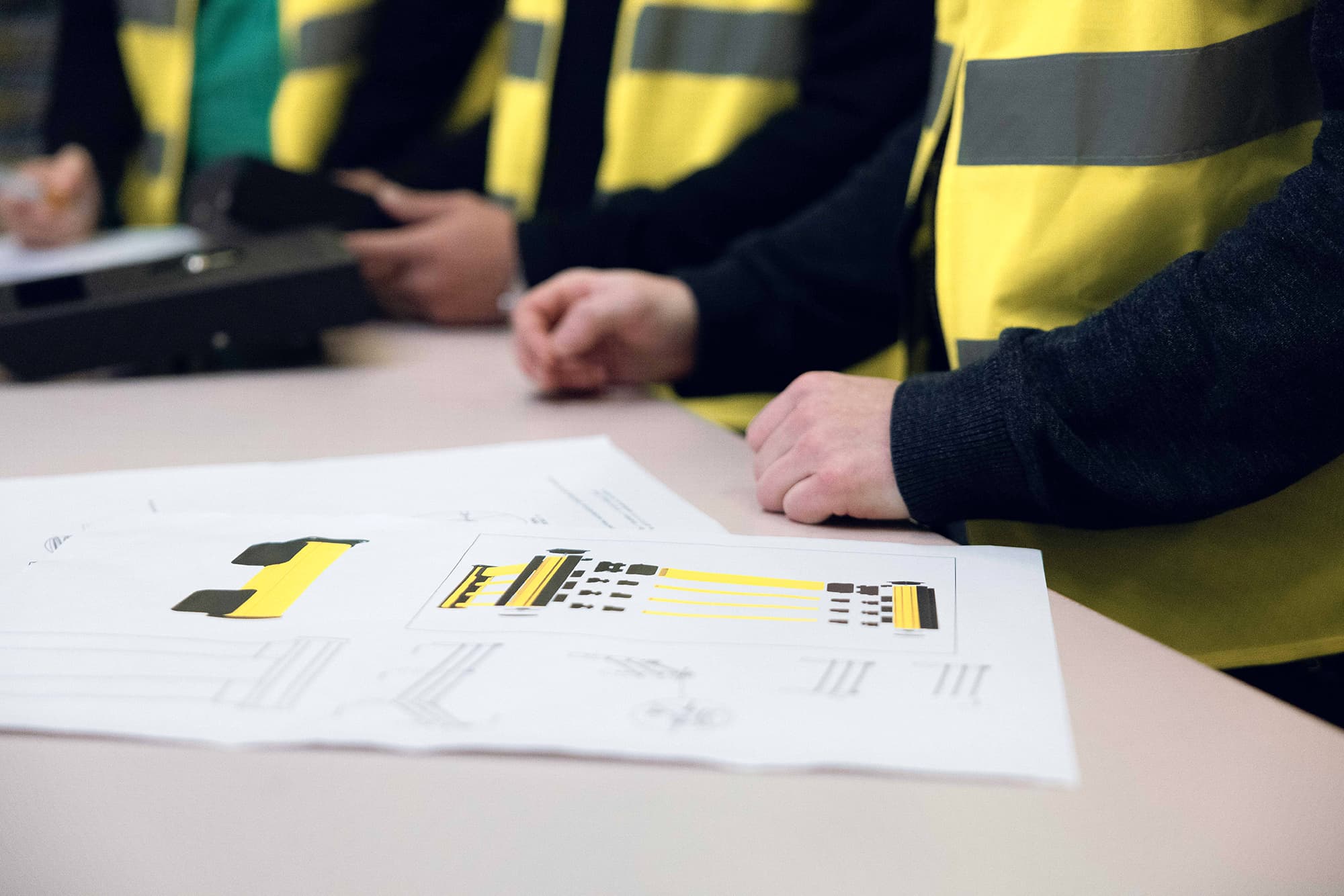
Technical documentation in the sense of the EU legislation does not primarily refer to an instruction handbook but to documents that serve as proof that the machinery is safe and conforms to the Regulations.
This documentation is also referred to as the “technical file”. It must contain the risk assessment, design documents, such as drawings and diagrams, safety-related calculations, and test reports.

What’s new in the technical file under the Machinery Regulation?
Risk assessment must be performed for machinery that involves coexistence or direct cooperation of people and machinery. Such machinery usually does not feature guards and is used in a collaboration space. This applies to collaborative robot applications and industrial mobile robots. Safety of such applications does not only depend on the sensors installed on the equipment but also on speed and force reduction as well as clear demarcation of the collaboration space. That is why a written risk assessment report is needed.
Risk assessment must also be performed for systems featuring several machines that cooperate. This is not new but stated expressly in the Machinery Regulation for the first time.
Risk assessment reports now need to detail the connection between a risk identified, the safeguards used to reduce it and the respective health and safety requirement from Annex III of the Machinery Regulation. The risk assessment report must allow finding out which of the requirements from the Machinery Regulation are applicable, which have been met, and how that is achieved.
If harmonized standards are applied, the requirements from the standards should also be allocated to the risk reduced. The application of only a part of a standard is expressly allowed.
The objective of these more stringent requirements is to ensure traceability of the measures taken. A manufacturer must be capable of proving that the product is in conformity with the Regulation not in general terms but in depth.
Cyber-security for machinery
Since machinery is increasingly controlled by software and communicates via onsite networks and sometimes via the Internet, cyber security has become a major concern.
The EU’s NIS2 Directive requires companies operating machinery and systems to protect their operations from cyber-attacks, particularly if they are considered critical infrastructure. The list of relevant operations has been extended to manufacture of electrical equipment and machinery.
Operating companies therefore need cyber-secure machinery and systems. The Machinery Regulation now introduces minimum rules for protection against “corruption” of the safety functions of the machine. In addition to standard risk assessment, manufacturers need to identify cyber threats and assess the attack potential on safety functions. Suitable protective measures must then be taken to ensure machinery is safe by design and default. Thus, the Machinery Regulation deals with only one aspect of what is more generally regulated by the CRA, the Cyber Resilience Act* of the EU.
*The official designation of the CRA is Cyber Resilience Regulation (EU) 2024/2847.
Changes in the EU Declaration of Conformity
One of the most frequently asked questions regarding the Machinery Regulation is what needs to be changed in the Declaration of Conformity (DOC). The answer is simple but brings up a few problems. From January 20, 2027, onward only the Machinery Regulation (EU) 2023/1230 must be referenced on the DOC. Until January 19, 2027, the Machinery Directive 2006/42/EC remains applicable.
Which standards should appear on the DOC?
What can you do if you do not know exactly when a machinery system will be completed or an individual machine from a series will be passed on to a distributor or end user?
Two things can be done:
Ensure that the machinery meets the requirements of the Machinery Regulation as early as possible.
Mention both the Machinery Directive and the Machinery Regulation on the DOC clearly stating that, the product meets the Machinery Directive until 19th January and the Machinery Regulation from 20th January 2027.
Another question troubling many is a little more difficult to answer: Which standards should appear on the DOC?
It may well be that a list of harmonized standards for the Machinery Regulation will not be available on January 20, 2027. Or standard you currently have on your DOC may not be on the list that is available.
Since most of the machinery safety standards will not undergo much change due to the Machinery Regulation, you can simply continue using them beyond the “magic date” and you can also list them in your DOC. But be sure that all standards in your DOC are on the list last published by the EU for the Machinery Directive (the most recent change has been published on September 7, 2026).
The only other change in the DOC is that you do not need to indicate the “person authorized to compile the technical file” anymore. It is assumed that this natural or legal person is either the manufacturer, the representative of the manufacturer or the importer, depending on who of these places the machine on the market. The contact information and role of these economic operators will appear on the DOC anyway, making it unnecessary to state them a second time.
Digital instructions and long-term access to documentation
Technical documentation – called “instructions” in EU legislation – must be provided with every machine.
When it comes to large machinery or even machinery systems, hundreds of pages in several folders may have to be supplied. But such paperwork is bulky to handle and difficult to search for specific information.
With the Machinery Regulation, it is now allowed (but not mandatory) to provide the instructions in digital format. Some added requirements come with this allowance, however. The instructions must be
printable
storable
retrievable (from the machine control system or the web)
If a manufacturer chooses to supply the instructions for use in digital format, he must keep them available for download from the internet for the entire service life of the machine or at least ten years. This makes it necessary for manufacturers to set up a content server which can provide the exact instruction handbook for an individual machine within minutes.
Since instructions may contain important safety information or details that are urgently needed in a failure or emergency, access must be easy. It is good practice to put a QR or barcode on the name plate of the machine and indicate that it leads to the instructions. The same can and should be done for access to the Declaration of Conformity. It should not normally be necessary to sign on with specific credentials to the website before being able to download the information.
<illustrations – pile of folders stuffed with paper … and Handbook icon and QR code next to it>
The updated definition of “partly completed machinery”
Likely one of the most frequently discussed issues around the Machinery Directive was and still is “partly completed machinery”. Manufacturers and operators alike had difficulty understanding the limits and exact implications of the definition in the original text.
Two details are remarkable about this change and will help settle many previous disputes:
Partly completed machinery is meant to become machinery only after an integrator has added components or integrated the assembly into a machine.
The definition always had and still has three criteria: (1) partly completed machinery is an assembly of several parts, at least one part is movable; (2) partly completed machinery cannot perform a specific application by itself; (3) it is meant to be incorporated into or assembled with machinery or other equipment. So far, many interpreted the definition to mean that only one of the criteria (2) or (3) must be fulfilled for the assembly to be partly completed machinery. The new formulation makes clear that all three criteria must be met.
What are the implications of this improvement?
The integrator of partly completed machinery becomes the manufacturer of the resulting machine and is responsible for its safety, CE Marking and the DOC. The manufacturer of partly completed machinery can only settle some but not all safety issues in the design. Which risks he mitigates and which he leaves for the integrator to take care of, is his choice and may be agreed upon in a contract.
Assemblies that do not meet all criteria are either machinery needing a CE Mark and DOC or are not covered by the Machinery Regulation at all.
Another vital clarification regarding “partly completed machinery” is found in Annex XI. The definition of the “assembly instructions” for partly completed machinery has been extended and a list of minimum requirements has been added.
The two most important additions are that manufacturers of partly completed machinery must
provide information on safety features included and on those to be added by the integrator
describe the operation and maintenance of partly completed machinery