Subchapter 5.3
CE Marking of modified machinery
Retrofitting machinery is often triggered by the need for changes in production or the desire to continue using an old system for a few more years. However, old systems must operate as safely as new ones in the EU. Therefore, used machinery may have to be CE marked after a modification as of January 2027. But only if the modification is “substantial”.
When is a modification considered “substantial”?
The Machinery Regulation defines as follows:
“Substantial modification means a modification of machinery or a related product, by physical or digital means after that machinery or related product has been placed on the market or put into service, which is not foreseen or planned by the manufacturer, and which affects the safety of that machinery or related product, by creating a new hazard, or by increasing an existing risk, which requires:
(a) the addition of guards or protective devices to that machinery or related product the processing of which necessitates the modification of the existing safety control system; or
(b) the adoption of additional protective measures to ensure the stability or mechanical strength of that machinery or related product;”
When you break it down, this clumsy definition limits the term “substantial” to modifications that are relevant for safety. The person or company (not necessarily the original manufacturer) will have to assess the safety impact of the planned modifications.
Assessing planned modifications
Most maintenance or repair jobs are not considered “substantial modifications”. For instance, you may have to replace defective components such as a motor, transmission parts, or a hydraulic cylinder. That is not considered a modification but a repair. Even if you replace safety switches, safety relays or an entire PLC, that does not necessarily mean you have substantially modified the machine. In cases where the functions remain unchanged or where identical or functionally identical parts are installed, this is not a substantial modification. Also, the objective of an upgrade or modernization of machinery may simply be to improve safety. Any change for the better will not be “punished” by bureaucratic burdens.
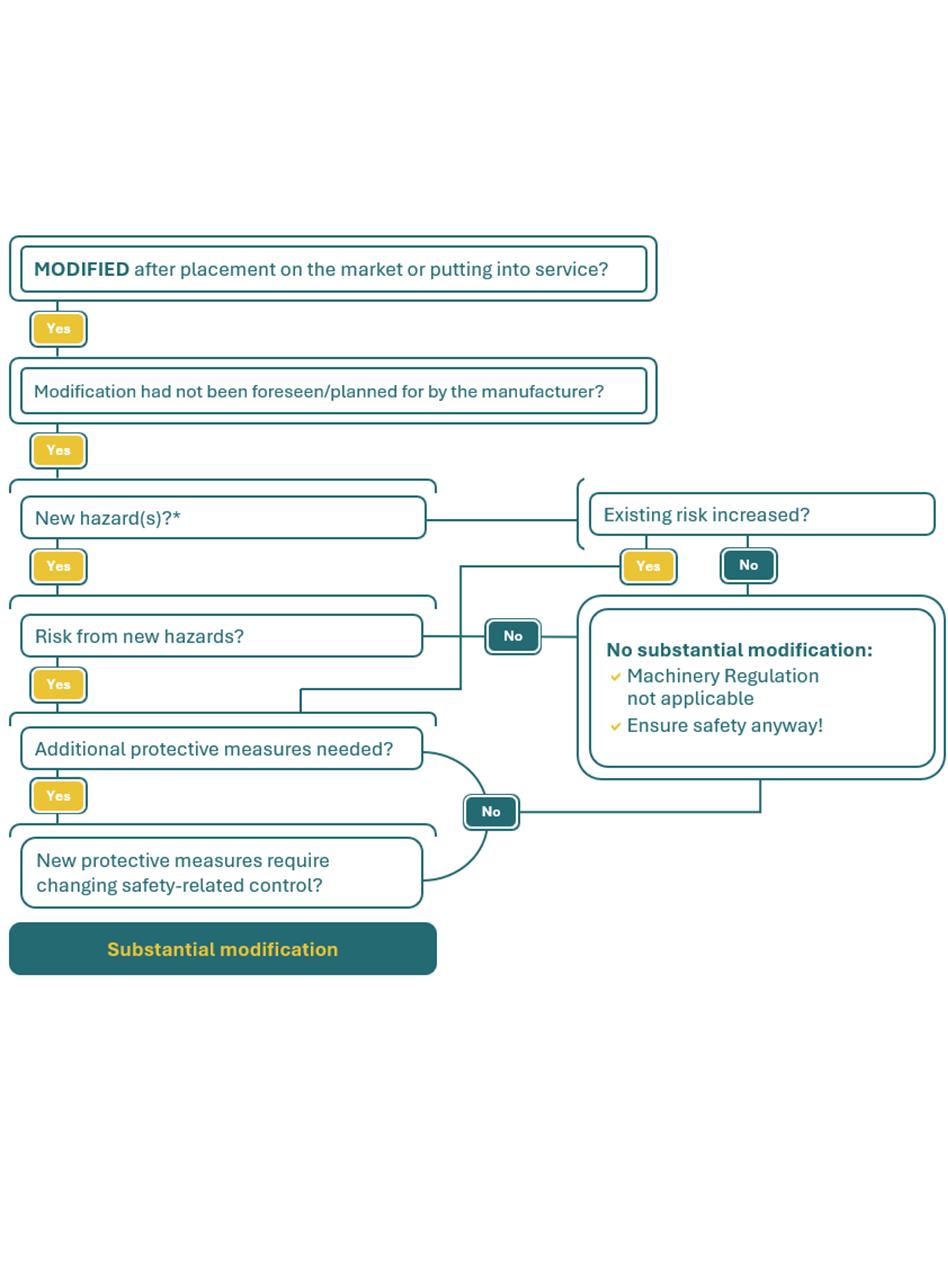
The somewhat cumbersome text in the Machinery Regulation outlines an evaluation procedure with six steps:
Is the machine modified after it has been placed on the market or put into service?
Had the modification not been foreseen by the manufacturer of the machine (described or even offered as an option)?
Does the modification create a new hazard or increase an existing risk?
Are additional protective devices needed to deal with the new hazard or to reduce the increased risk?
Do the additional protective devices also make a change of the existing safety-related control system necessary?
And/or are additional protective measures needed to ensure the stability or mechanical strength of the machine?
Ask these questions in sequence. If you can answer the first five or even all of them with yes, the modification is substantial and the machine needs a (new) declaration of conformity. If you can answer any of the first five with “no”, it is not a substantial modification. It is good practice to document the answers to the above questions in an evaluation protocol.
Download the Template for Assessment of Substantial Modification
Steps to take in case of a substantial modification
What to do if the modification is a substantial one? Take these steps to ensure everything is ready for CE Marking:
Describe the planned modification.
Perform risk assessment, particularly for new workstations, procedures and new interfaces with other machinery.
Install guards and control guards as needed. Ensure the functional safety is state-of-the-art (Conforming to ISO 13849-1/IEC 62061).
Test safeguards and safety functions and document the results.
Draw up or update instructions for use.
Attach a new nameplate with the CE Mark next to any existing one (do not remove the original nameplate).
Issue the declaration of conformity.
Responsibilities connected to substantial modification
Who is responsible for ensuring the safety of a modified machine and to issue the Declaration Of Conformity?
The natural or legal person making the modifications. That may be the company using the machinery, the original manufacturer or any other individual or organization.
Professional users will be especially interested in having safe machinery, because operation is otherwise not allowed under the EU Work Equipment Directive 2009/104/EC. Even if a modification does not lead to safety-related changes, a safety check-up should be made every time manufacturing facilities are modified. Check that:
every risk from the operation is mitigated by a suitable safeguard
required safeguards are in place and functioning
any housings, guards and windows in them are undamaged
none of the cables, switches or electric housings are defective
liquids are not leaking from hose lines, pipe connections or vessels
Download the Safety Checklist for Used Machinery Equipment based on EU directive 2009/104/EC