Knowledge
Forklift Pedestrian Safety: How to Plan Safer Traffic Flow

Forklift pedestrian safety starts with how traffic is planned inside the facility. A clear warehouse traffic safety plan can support forklift accident prevention by reducing unclear routes, unsafe crossings and mixed movement between people and vehicles.
In warehouses and production sites, forklift routes often cross areas used by operators, maintenance staff, visitors and temporary workers. Risk increases where visibility is limited, where vehicles turn or reverse, where pallets are staged, and where pedestrians need access to workstations, doors, packing areas or welfare spaces.
A safer layout helps people and vehicles move with less uncertainty. It should make walking routes clear, reduce uncontrolled crossings and protect areas where people work close to forklift traffic.
Assess forklift traffic risk
A forklift traffic plan should be based on real movement.
Walk the facility during normal working hours. Follow the forklift routes. Watch where people walk, where pallets are placed and where drivers need to turn, reverse or stop. Review the layout during peak activity, not only when the area is clear.
Pay extra attention to points where movement changes. These areas often carry higher risk because drivers and pedestrians have less time to react.
Typical areas to observe include:
- Loading docks
- Packing areas
- Doorways
- Racking ends
- Vehicle crossings
- Pedestrian entrances
- Maintenance access points
- Temporary storage zones
A layout that works on paper can still create risk if pallets block visibility, if pedestrians take shorter routes or if forklift traffic has increased since the layout was first planned.

Separate pedestrians and forklifts
The safest pedestrian route is separated from forklift traffic.
Full separation is not always possible in active warehouse and manufacturing environments. People need access to machines, packing stations, offices, welfare areas and service points. Forklifts need access to racking, goods-in, dispatch and production flow.
Where separation is possible, pedestrian walkways should be direct, visible and protected. A route that creates unnecessary detours is less likely to be followed. This is especially important in areas used by visitors, temporary workers or staff who do not work in the area every day.
Physical separation can include:
- Pedestrian segregation barriers
- Pedestrian gates
- Topple Barriers
- Dock gates
- Marked and protected crossings
The layout should make it clear where people can walk safely and where vehicles are expected to move.
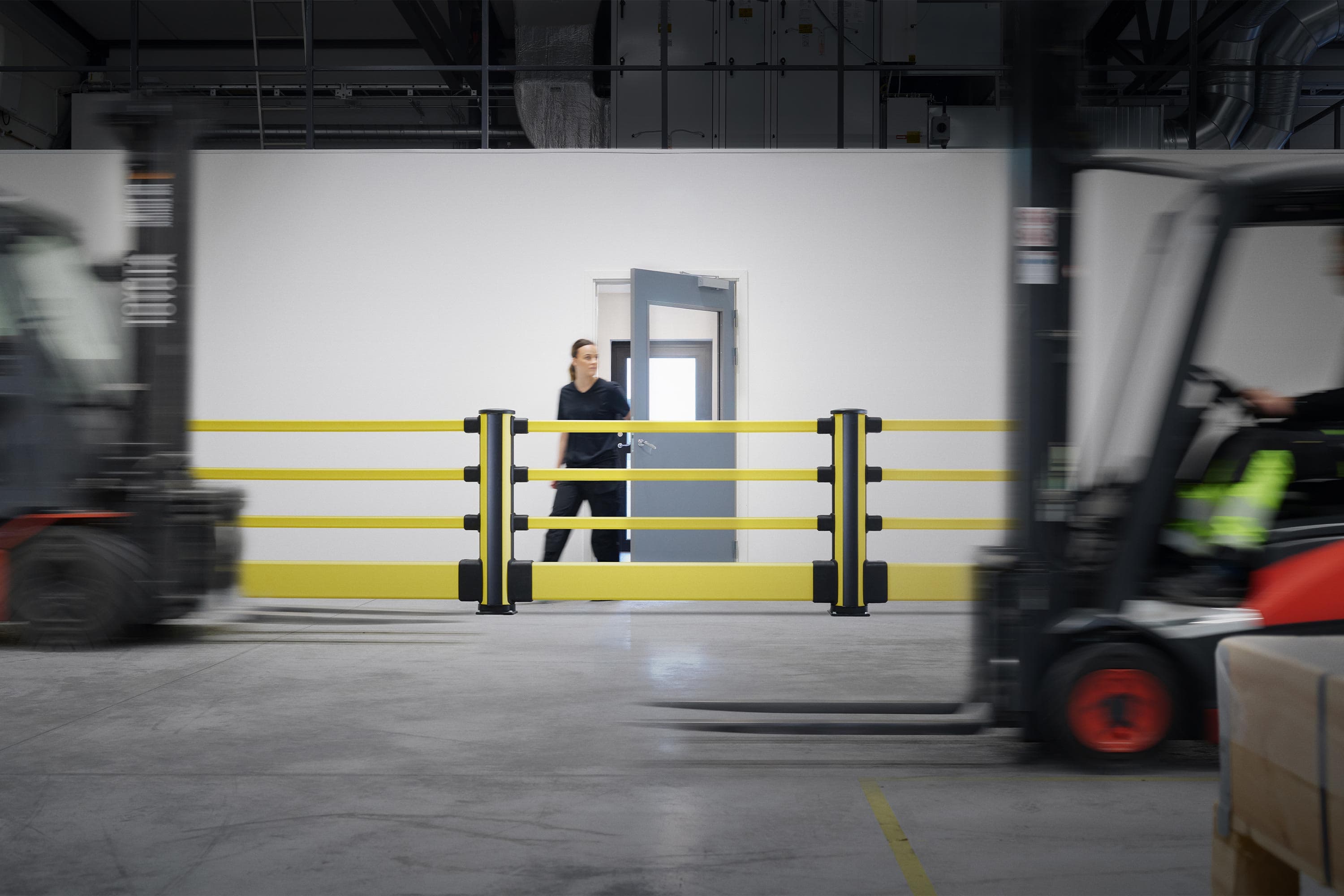
Control forklift crossing points
Crossings should be controlled, visible and placed where both drivers and pedestrians have clear sightlines.
A poor crossing location can create risk even if it is marked correctly. Avoid placing crossings directly after blind corners, close to forklift turning zones, behind doors or in areas where pallets are often stored.
A controlled crossing should:
- Be visible from both directions
- Give forklift drivers time to slow down
- Keep waiting pedestrians outside the vehicle route
- Guide pedestrians to one defined crossing point
- Use gates where access needs to be physically managed
- Use barriers to prevent uncontrolled entry into vehicle zones
A crossing is part of the traffic system. It should be planned together with vehicle routes, pedestrian routes, speed limits, visibility and access needs.
Set safe forklift speeds
Forklifts are often capable of travelling faster than the speed that is suitable in areas where people work or walk. The maximum speed of the vehicle should therefore not be treated as a safe operating speed for every part of the facility.
Speed limits should be set by zone. A wide transport aisle, a loading area, a blind corner and a pedestrian crossing do not carry the same level of risk. Visibility, turning movements, traffic frequency, floor conditions, load handling and pedestrian exposure all affect what speed is appropriate.
As practical guidance, WorkSafe Victoria recommends limiting forklift speed to walking pace, around 5–7 km/h, where pedestrians may be present. Other industry references often place high-pedestrian or high-risk zones around 3 mph, approximately 5 km/h. The exact speed limit should always be based on a site-specific risk assessment.
Speed limits should be clearly posted, enforced and reviewed when the layout changes. Where signs and routines are not enough, companies can consider technical controls such as speed-limiting devices or zone-based speed control to prevent forklifts from exceeding the permitted speed in defined areas.
Know floor marking limits
Floor markings are useful for guiding movement and showing intended routes. They can work well in areas with low traffic speed, good visibility and limited pedestrian exposure. But they do not provide physical protection.
In higher-risk areas, markings should not be the only control. This applies where forklifts pass close to people, where loads reduce driver visibility, where pedestrians wait near traffic routes or where vehicles turn, reverse or enter from aisles.
In these areas, workplace safety barriers may be needed to create a physical boundary between pedestrians and forklift traffic. Physical protection becomes more relevant when markings show the route but cannot reduce the exposure. This is common in areas with frequent forklift traffic, blind spots, large loads, mixed movement or limited space between people and vehicles.
Choose workplace safety barriers
Workplace safety barriers should be selected based on what they need to protect and what type of impact they may need to withstand.
In forklift traffic areas, barrier choice should consider:
- Vehicle type
- Vehicle weight
- Travel speed
- Load weight
- Impact angle
- Traffic frequency
- Distance to pedestrians
- Space needed for turning and handling
Forklift-rated barriers are relevant where the risk assessment shows a need for physical protection. They help create a stronger boundary than visual guidance alone.
Barrier planning should also avoid creating new risks. A barrier that blocks a natural route can push people into another exposed area. A gate in the wrong position can place pedestrians too close to turning forklifts. The full movement around the protected zone should always be considered.
Prevent unsafe shortcuts
People usually take shortcuts when the planned route is too long, unclear, blocked or placed away from the task. In a warehouse, this can quickly create uncontrolled crossing points.
Common causes include:
- Walkways that do not connect to real destinations
- Gates placed too far from the point of use
- Barriers that protect one area but block another route
- Crossings placed close to turning zones
- Storage areas that block pedestrian routes
- Temporary pallets placed inside walkways
- Poor separation between packing areas and vehicle routes
Shortcut behaviour gives useful information. It often shows where the traffic plan needs to be adjusted so that the safe route also becomes the route people are most likely to use.
Review warehouse traffic safety
Forklift pedestrian safety should be reviewed when the operation changes.
New racking, new machines, changed goods flow, higher throughput or new vehicle types can all change the risk level. A route that worked before may become unsuitable when traffic volume increases or when visibility changes.
Regular review should include:
- Current forklift routes
- Current pedestrian routes
- New crossing points
- Blocked walkways
- Damaged barriers
- Changed storage patterns
- Areas with repeated near misses
- Areas where people and vehicles now mix
A modular protection system makes it easier to adjust the layout when the facility changes. Barriers, gates and protected routes can be extended or repositioned as traffic flow develops.
Axelent supports warehouse and industrial environments with modular systems for pedestrian routes, impact protection, machinery areas and exposed infrastructure. The system can be planned around traffic flow and adapted when operations change.
Forklift pedestrian safety checklist
Use this checklist when reviewing forklift pedestrian safety in your facility.
- Map forklift and pedestrian routes during real operation
- Identify where people and vehicles share space
- Review crossing points, blind corners and doorways
- Check loading, dispatch and packing areas
- Review where forklifts reverse, turn or stop
- Identify shortcut behaviour
- Check if walkways are blocked or unclear
- Decide where markings are enough
- Decide where physical separation is needed
- Match barriers to vehicle type, speed and impact risk
- Review the layout when operations change
FAQ
Related articles

Impact Protection for DreamLand’s New Distribution Centre
Safety was a key consideration from the design stage of the new DreamLand site in Bilzen-Hoeselt. Together, the two warehouses cover more than 40,000 m² and include 44 loading docks. To protect employees, critical infrastructure and the continuity of logistics operations, DreamLand invested in targeted impact protection from Axelent.

Pallet Racking Protection: Prevent forklift damage to uprights and aisle ends
Every forklift impact against a rack upright creates damage that spreads beyond the point of contact. One bent upright lead to inspections, repairs, downtime and reduced load-bearing integrity. Repeated impacts shorten the lifespan of the entire racking system. Pallet racking protection reduces that risk by protecting the areas where collisions happen most often: uprights, aisle ends and exposed traffic zones.

Warehouse Barrier Systems: Choose the Right Protection for Every Zone
Every unprotected zone in a warehouse is a problem that hasn't happened yet. This guide helps you choose the right barrier system for each area in your facility, from high-traffic forklift routes to loading docks and pedestrian crossings.

How to build a strong workplace safety culture
A strong safety culture is essential for organisations that want to reduce risk, protect people and support long-term performance. But building a safety culture in the workplace requires more than policies and procedures. It requires leadership, open communication and continuous improvement.

Axelent and ABB: A Partner Every Step of the Way
Safety solutions enabling safe machine operations and forklift traffic in ABB Robotics training facility.

Forklift Accident Statistics & How to Prevent Them
An in depth look at forklift accident statistics in the UK and other countries, before explaining forklift safety tips and what you can do to prevent these accidents from happening.